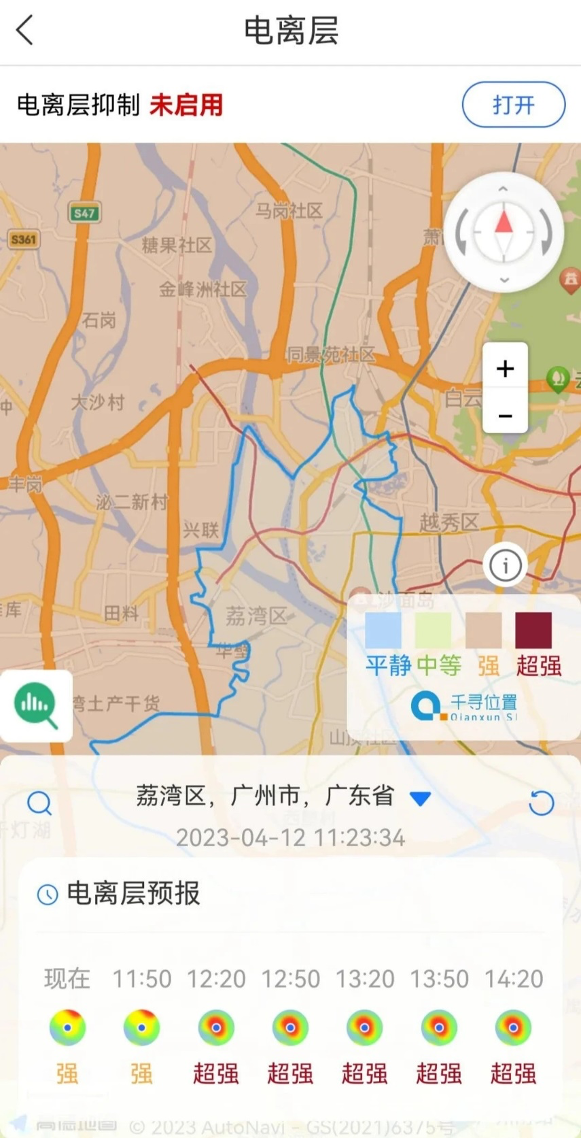
Qianxun SI launched widespread ionospheric forecasting feature
As one of the main error sources of the Global Navigation Satellite System (GNSS), the ionosphere has always been a critical factor affecting the accuracy of high-precision positioning. With the arrival of the 27th solar activity cycle (expected to peak in 2025), the ionosphere becomes more active.
In construction sites such as engineering construction, road and bridge management, mining, forestry, land and topographic surveying, many high-precision RTK terminal devices often face the issue of not being able to "fix" their positions, and the "fixed accuracy" index can hardly meet the calculation requirements.
To address the challenges posed by ionospheric disturbances, Qianxun is the industry's first to launch a comprehensive solution to counter ionospheric interference. Currently, Qianxun ionospheric activity query tool has been used by millions of surveying and mapping users nationwide.
At the algorithm level, Qianxun has completed the anti-ionospheric algorithm upgrade by relying on seven years of ionospheric activity data and using tools such as machine learning. Combining this with the terminal algorithm's quality factor, Qianxun can provide ionospheric suppression function, effectively solving positioning problems in highly active ionospheric conditions.
The reason to realize the ionospheric forecasting function is that with the approach of highly active ionospheric years, ionospheric changes will not only intensify but may also present more anomalies. This requires not only continuous observation of ground stations but also continuous iterative optimization of the algorithm model. With the ability to forecast the ionosphere, Qianxun ionospheric suppression algorithm model can optimize itself through autonomous learning based on prediction and result verification. Ultimately, it will improve the positioning effect under ionospheric activity changes and help to double the operational efficiency.